Upload your case file and put it in front of a panel of simulated jurors matched to your venue. In minutes, you see how they vote, what they would award, and why. When the case changes, run it again.
Upload your files and ask a question. A panel built for your venue answers in minutes.
Test themes, openings, exhibits, and witness video on jurors matched to your venue. Keep what moves the panel, cut what doesn’t, and see who you’d strike.
Test your story →Get the verdict distribution and damages curve for the claim’s actual venue. Set reserves on evidence and walk into mediation knowing the range.
Price the exposure →An independent, evidence-based answer on whether to settle or fight, for any live matter, in days. Bring it to your next strategy call with outside counsel.
Get the answer →A live focus group tests one version of your case. A simulation takes minutes, so you can test them all. Change the closing, swap an expert, lead with a different theme, and watch how the panel moves.
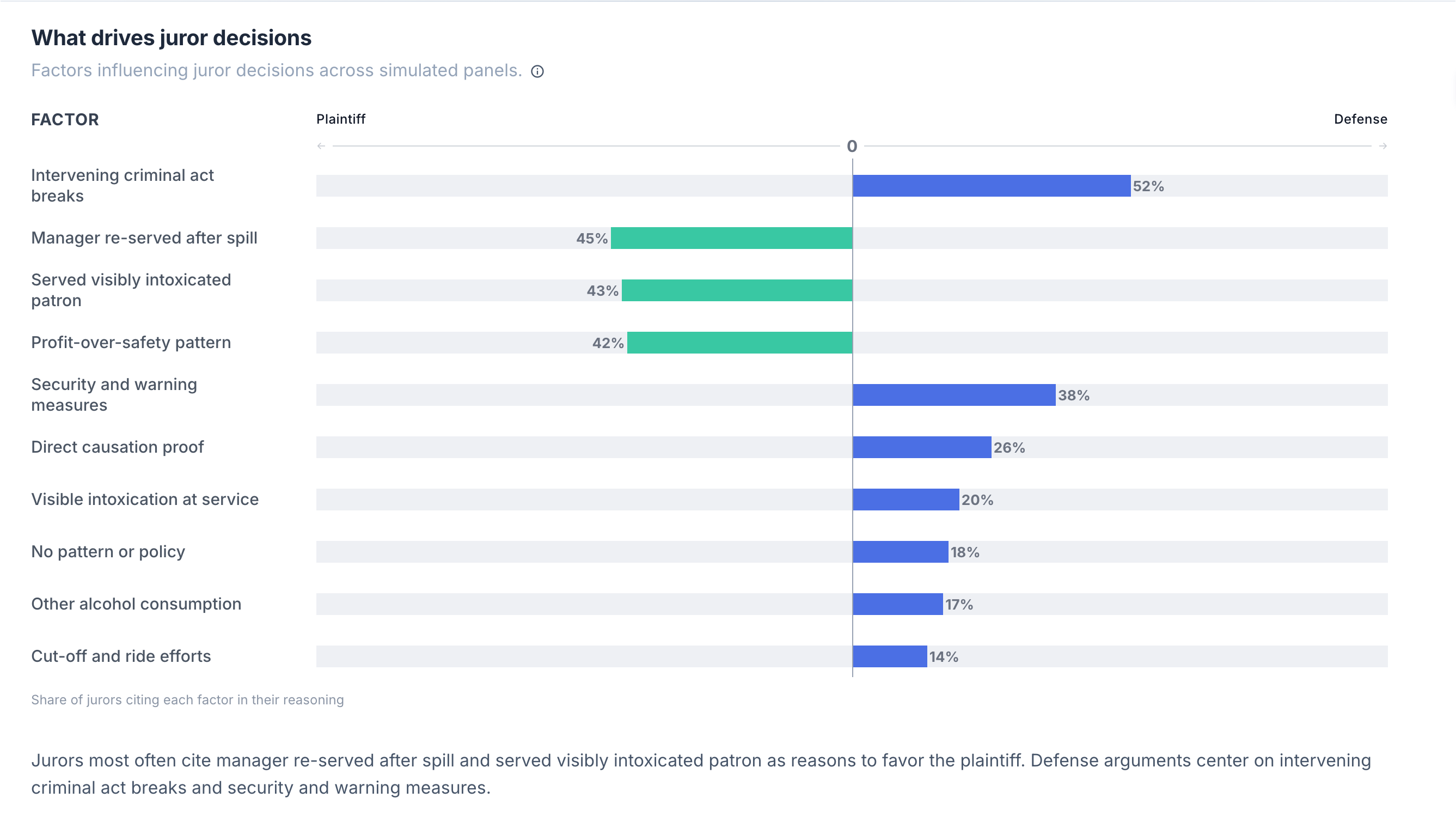
From a dram shop case. Each row shows the share of jurors who cited that fact, ranked by how strongly it pushed them toward one side. Whether the bar kept serving a visibly drunk patron pulled hardest toward the plaintiff.
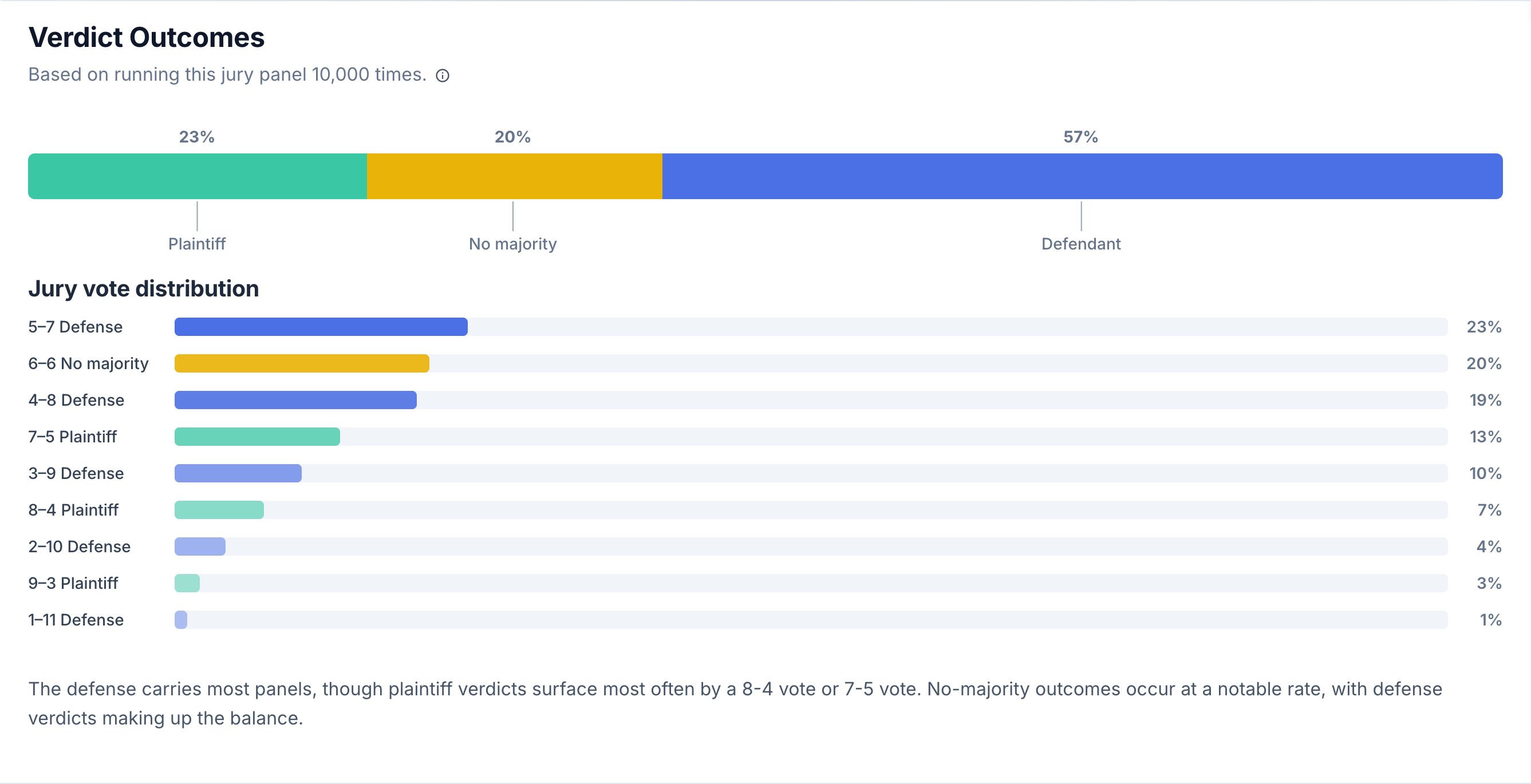
Every claim gets the same treatment: a panel matched to the claim’s venue, 10,000 jury combinations, and a full damages curve. Run it when you set reserves, before mediation, and again when new facts land. The method stays the same across the whole book.
One case, run 10,000 ways. Every jury the venue could seat, grouped by final vote. In this case, a strong defense position with a hung-jury risk worth pricing.
When a matter lands on your desk, the honest answer is usually a range and a set of reasons. Get both from an independent panel, then use them to pressure-test outside counsel’s strategy and budget.
Group your jurors into a panel and they argue like a real jury. They respond to each other, concede points, and change their votes. You see who frames the debate, whose argument carries the room, and who won’t budge.
In a published head-to-head test, both reached the same verdict. The difference is what you can do with the panel afterward.
“We ran our materials through GPT and it gave the logical verdict. The Viewpoints jurors answered the way real people do, with the same inconsistencies, and matched what we saw in our live mock trial.”
“The simulated panel matched our mock jury and surfaced broader themes than we’d tested for.”
Most legal AI reviews documents, drafts contracts, or researches precedent. Viewpoints.ai models how people decide. It shows how jurors in your venue react to your story, your evidence, and your arguments, and which themes drive their votes.
Treat them as directional. The most reliable value is in the themes that drive votes, the ability to rerun and compare versions, and the deliberation dynamics. That said, in a published head-to-head test (DRI’s For The Defense, May 2026) the simulated verdict matched a live human jury on the same case.
Yes. Group any of your jurors and they respond to one another like a real panel: they push back, concede points, and change votes. You can designate a foreman and watch which voices carry the room.
Yes. Panels are built to mirror the jury pool of any U.S. venue, across age, education, occupation, income, and the life experiences that shape how jurors hear a case.
Yes. The platform is SOC 2 Type II audited and built for privileged case material, with strict access controls. We hold zero-data-retention agreements with our AI providers, and your case files are never used to train AI models, ours or anyone else’s. Your files and findings stay confidential.
We’ll build a panel matched to your venue for one of your live matters, then walk through the verdict, the themes behind it, and an interview with any juror you choose.
Book a demo